Johannes Grützke
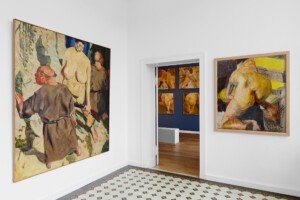
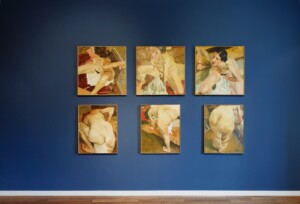
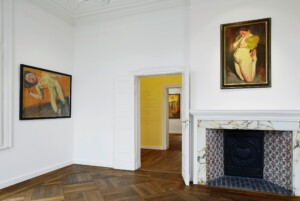
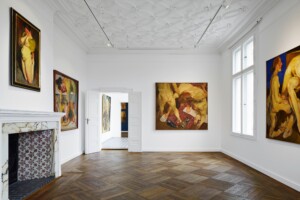
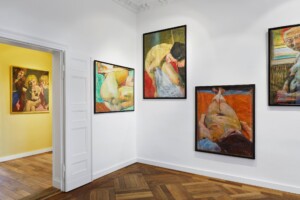
From March 25 to June 19, 2016 the Villa Schöningen shows more than 30 works by the Berlin painter, draftsman and graphic artist Johannes Grützke (*1937). On display are oil paintings and pastels dedicated to nudes.
Johannes Grützke, co-founder of the School of New Magnificence launched in 1973, which stylistically pursues an ironically fractured realism with socio-critical relevance, presents bodily states of sometimes disturbing realism.
“Grützke’s pictures are unique, admittedly extravagant contributions to a social and moral history of the Federal Republic. They comment in a bizarre way on social role-playing, attempts at emancipation and infantile regressions, singles culture and compulsive group behavior, the battle of the sexes, women’s power, sexual liberation and sexual convulsions, ideological contortions and collective neuroses. Grützke is a sensualist and a theatrical artist. His idiom is body language. He depicts the psychic mechanics and confused instinctual life in a theater of the flesh…. .” writes Eduard Beaucamp about the “lateral painter and contemporary universal actor.”
Johannes Grützke’s nude retrospective at Villa Schöningen presents the lush, extravagant visual language of the artist, still largely unchallenged by the intellectual art establishment, who is one of the most important German painters of post-war history.
In addition to the artworks, the film einverstanden. im universum des johannes grützke by Bernt Engelmann and Gisela Wunderlich will be shown, which provides insights into the artist’s life as a sculptor, experience violinist, actor, stage designer and book author, among other things.

 © Villa Schöningen, Fotos: Noshe
 © Villa Schöningen, Fotos: Noshe
 © Villa Schöningen, Fotos: Noshe
 © Villa Schöningen, Fotos: Noshe
 © Villa Schöningen, Fotos: Noshe
 © Villa Schöningen, Fotos: Noshe